
For years, the technical interview has operated under a fairly simple premise: give a developer a problem, take away most of their usual resources, and see whether they can solve it. No Google, no Stack Overflow, no colleague sitting beside them and, increasingly, no AI.
There’s just one problem with that approach: it bears less and less resemblance to how software engineers actually work.
AI has rapidly become part of the development environment. Engineers use it to explore unfamiliar codebases, generate boilerplate, write tests, troubleshoot errors, refactor code and evaluate different approaches to a problem. If an engineer will be expected to use these tools effectively once they join your team, banning them during the interview raises an obvious question: what exactly are you testing?
Perhaps the issue isn’t whether AI belongs in the technical interview. Perhaps the technical interview itself needs to change.
The interview is becoming less like the job
This problem didn’t start with AI. Developers have complained about technical interviews for years because algorithm puzzles, whiteboard exercises and coding challenges can end up testing a candidate’s ability to prepare for an interview rather than their ability to build production software.
AI simply makes that disconnect harder to ignore.
HackerRank’s 2025 Developer Skills Report found that 66% of developers would prefer to be evaluated on real-world skills, while 78% said technical assessments don’t align with the work they actually do. At the same time, AI is becoming a normal part of that work. Stack Overflow’s 2025 Developer Survey found that 51% of professional developers use AI tools every day.
That creates an increasingly strange situation: we remove a tool developers routinely use at work in order to determine how good they will be at the work.
Simply allowing AI into the interview doesn’t solve the problem, however. In many ways, it creates an entirely new assessment challenge.
If AI can solve the task, what are you actually assessing?
Imagine giving two candidates the same coding exercise and access to an AI assistant. Both might produce working solutions, but the process behind those solutions could be completely different.
One candidate understands the problem, gives the AI useful context, spots weaknesses in the generated code, questions its assumptions and improves the solution. The other accepts what the model produces with little scrutiny and happens to arrive at something that works.
The final output may look remarkably similar. The engineering capability behind it isn’t.
That’s why an AI-enabled interview can’t simply be a traditional coding test with an AI assistant switched on. Companies need to reconsider what the interview is designed to reveal. The goal becomes less about whether someone can produce code and more about whether they can arrive at a reliable solution, understand why it works and take responsibility for the decisions made along the way.
The skills worth testing are changing
An AI-era technical interview should expose the parts of engineering that AI can assist with but cannot reliably demonstrate on a candidate’s behalf.
Problem framing is one of them. Before writing code, does the candidate actually understand the problem? Can they identify missing requirements, challenge assumptions and clarify what success looks like? An interview could deliberately provide incomplete requirements and evaluate the questions a candidate asks before they start building.
Technical judgement becomes equally important. AI can generate several plausible solutions remarkably quickly, but choosing between them requires context. Candidates can be asked why they selected a particular architecture, library or implementation and then be given a new constraint. What happens if the system needs to support 100 times the traffic? What if the data is sensitive? What if another team needs to maintain it? The value lies in understanding the trade-offs, not simply arriving at an answer.
Verification may become one of the most valuable engineering skills in an AI-assisted environment. Stack Overflow’s research illustrates why: while AI usage among developers is high, 46% say they distrust the accuracy of AI output. One of the biggest frustrations is receiving solutions that are almost correct, code that looks plausible enough to pass an initial inspection but contains a subtle flaw.
That suggests another kind of interview exercise altogether. Instead of asking candidates to produce code from scratch, give them AI-generated code containing subtle problems and ask them to review it. What’s wrong? What assumptions has the model made? What would they test? What would they change before allowing it into production? The ability to recognise plausible-but-wrong output may reveal far more than watching someone remember syntax.
Debugging offers another opportunity. Generating code is becoming cheap; understanding why code doesn’t work isn’t. A candidate could be given a broken application, failing test or poorly implemented feature and allowed to use whatever tools they normally would. The interviewer can then observe how they investigate the problem. Do they blindly follow AI suggestions, or do they form hypotheses, inspect the surrounding system and distinguish symptoms from root causes?
There is also an entirely new competency worth evaluating: AI judgement. Strong AI users aren’t necessarily the people who prompt most often. They understand when AI can accelerate a task, when its output requires careful validation, and when security, privacy, complexity or context makes another approach more appropriate. Knowing when not to use AI may prove just as important as knowing how to use it.
Don’t assess the answer. Assess the interaction.
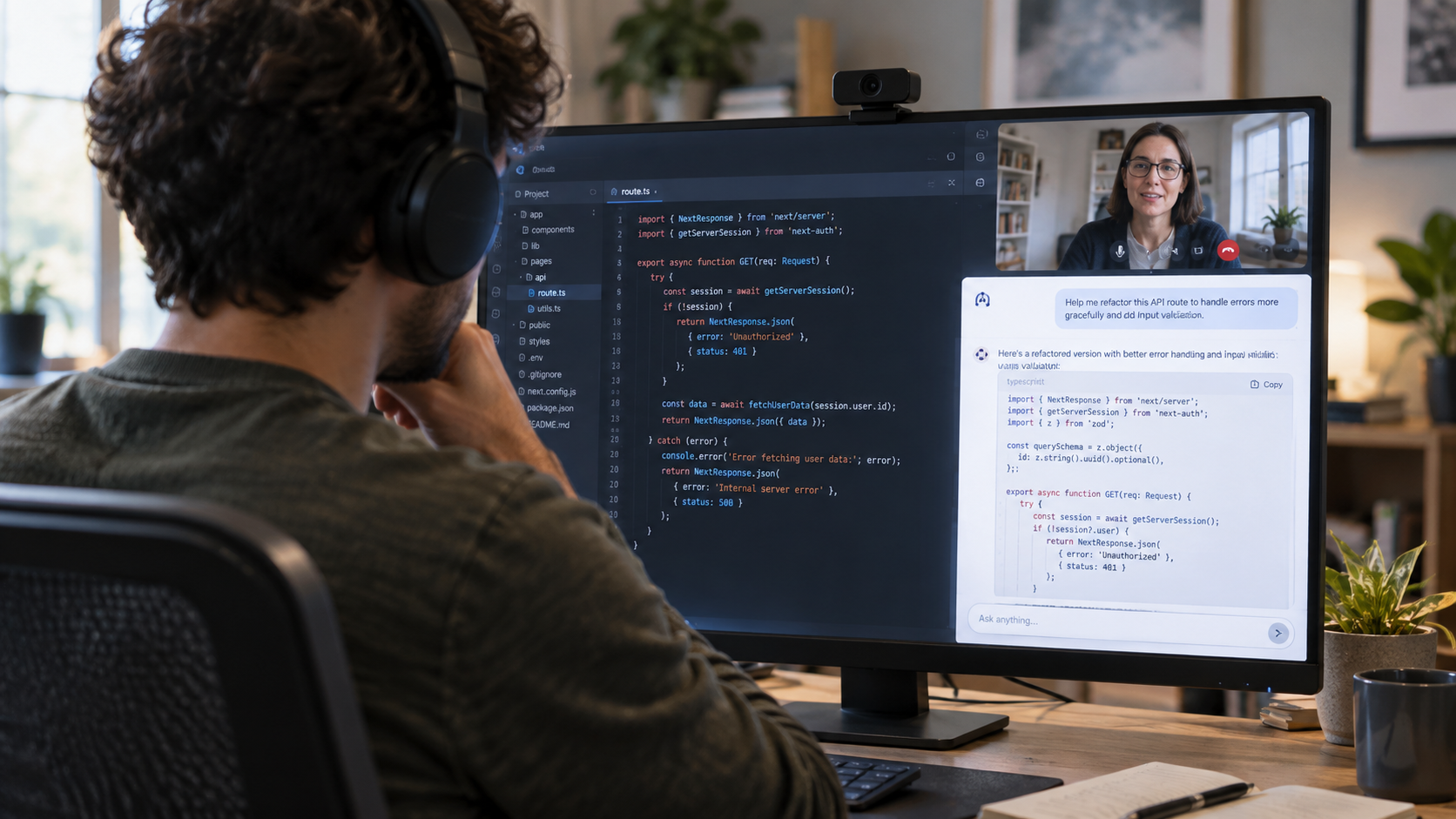
Taken together, these changes suggest a very different type of technical interview. Give the candidate a realistic engineering problem and access to the tools your engineers actually use, including AI. Then observe the process.
Ask candidates to explain their thinking as they work. Let them prompt the model, challenge its responses and modify the resulting code. Introduce a new requirement halfway through the exercise and see how they adapt. Ask why they accepted one suggestion and rejected another, and then discuss the finished solution.
In this kind of interview, AI is no longer interfering with the assessment. AI becomes part of the assessment.
What you’re really evaluating is whether the candidate can use increasingly powerful tools without outsourcing their judgement to them. That distinction matters because the ability to generate code is becoming less scarce, while the ability to understand, evaluate and take responsibility for that code remains very human.
The bigger hiring question
AI is forcing companies to confront something that was arguably already broken. If a technical interview can suddenly be passed simply because a candidate has access to an LLM, perhaps the interview wasn’t measuring the most valuable engineering skills in the first place.
Writing code still matters, of course. But as AI makes producing code faster and easier, differentiation begins to move elsewhere: understanding problems, making architectural decisions, recognising risk, debugging complex systems, communicating trade-offs and taking responsibility for the final result.
These are also the skills that sit at the heart of the broader shift we’re seeing in software engineering, away from simply completing tickets and towards engineers who understand the problem they’re solving and the product they’re building.
So perhaps the question isn’t whether candidates should be allowed to use AI during technical interviews. A better question is this:
If AI is part of how your engineers work, why isn’t your interview designed to assess how well candidates use it?