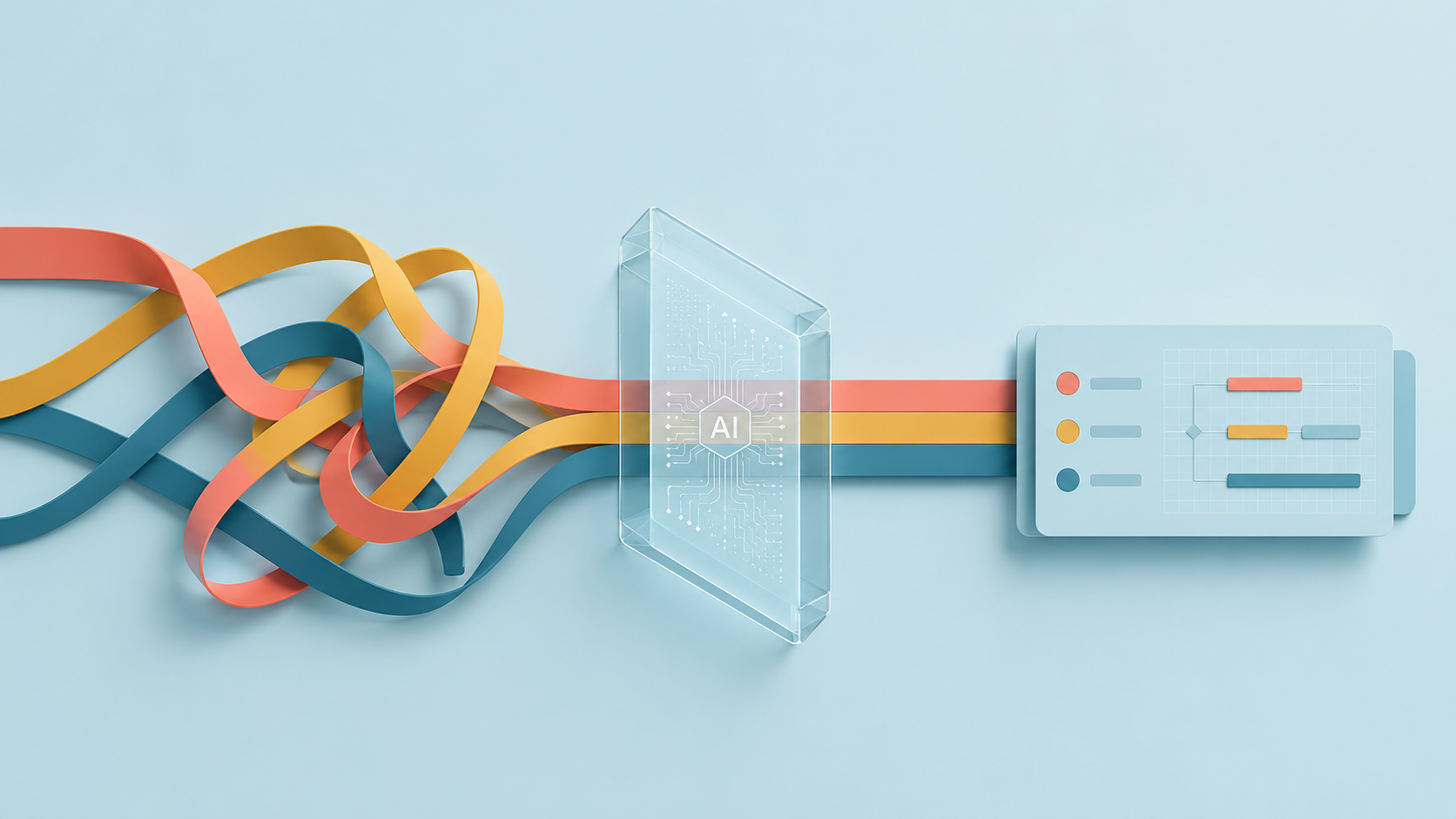

As AI reshapes software development, the question isn’t simply whether engineering teams will get smaller. It’s whether the traditional structure of those teams still makes sense.
For years, software engineering teams have been built around a relatively familiar structure. Front-end developers build interfaces, back-end developers manage systems and infrastructure, QA engineers test functionality, and engineering managers coordinate delivery. Specialisation has been the organising principle, with each role contributing a defined piece of the development process.
Artificial intelligence is beginning to challenge that model.
As AI coding assistants become more capable, the boundaries between engineering responsibilities are becoming less distinct. Developers can generate interfaces, write tests, troubleshoot infrastructure and explore unfamiliar codebases with assistance that would have been difficult to imagine just a few years ago. Tasks that once required specialist knowledge, or significant time to learn, are becoming more accessible.
This has prompted plenty of speculation about the future of engineering employment, including predictions that companies will soon need dramatically fewer developers.
But focusing exclusively on headcount risks missing the more interesting question: What happens to the structure of an engineering team when the work itself begins to change?
By 2027, the most significant shift may not be towards smaller teams, but towards teams organised around different capabilities, responsibilities and expectations.
From Specialists to AI-Assisted Generalists
Software engineering has always required a balance between breadth and depth. Specialists bring expertise to complex technical problems, while generalists connect different parts of a system and help teams move efficiently from concept to delivery.
AI is beginning to change that balance.
A developer who previously worked primarily on back-end services can now use AI assistance to build a functional front-end prototype. A front-end engineer can explore database queries, generate automated tests or investigate deployment issues without necessarily involving another specialist at every stage.
This doesn’t mean deep expertise is becoming obsolete. Quite the opposite. Complex architecture, security, performance optimisation and large-scale systems engineering still require substantial technical judgement. AI-generated code may be syntactically correct while introducing subtle problems that only an experienced engineer will recognise.
What changes is the amount of routine work that requires a dedicated specialist.
The result could be a greater emphasis on what might be called the AI-assisted generalist: an engineer with strong technical foundations who can work confidently across multiple disciplines, using AI to extend their capabilities without mistaking generated output for verified expertise.
These engineers won’t necessarily know everything. They will, however, be better equipped to move between problems, evaluate unfamiliar solutions and take responsibility for larger portions of the development process.
For engineering leaders, this raises an important question about hiring. Should teams continue recruiting primarily around narrowly defined technical stacks, or place greater weight on adaptability, systems thinking and the ability to solve problems across traditional boundaries?
Smaller Teams? Possibly. But Not Necessarily.
One of the most common assumptions about AI-assisted software development is that productivity gains will translate directly into reduced engineering headcount.
The reality is likely to be more complicated.
If a team of ten engineers can deliver the same output with eight, reducing headcount may appear to be the obvious commercial decision. But software development has rarely operated with a fixed amount of work waiting to be completed.
When the cost of building software falls, organisations may choose to build more of it.
Features previously considered too expensive become viable. Internal tools that sat indefinitely on the backlog can be developed. Teams can experiment with more product ideas, modernise legacy systems and address technical debt that has accumulated over years.
In this scenario, AI doesn’t necessarily eliminate demand for engineers. It changes the economics of what engineering teams can accomplish.We may see smaller teams responsible for individual products or workstreams, with fewer handoffs and less coordination overhead. At the same time, organisations may support more of these teams, expanding the scope of their engineering ambitions rather than simply reducing the workforce.
The distinction matters. A company that uses AI primarily to reduce development costs may make very different organisational decisions from one that uses the same technology to accelerate innovation.
Both approaches are possible. Neither should be mistaken for an inevitable outcome.
Technical Leadership Becomes More Important, Not Less
As AI makes code generation easier, the ability to determine what should be built, how it should work and whether it meets the intended objective becomes increasingly valuable.
This could shift the balance of engineering leadership away from coordinating implementation tasks and towards technical judgement, architectural oversight and product understanding.
Consider a team where engineers can generate substantial portions of an application with AI assistance. The immediate challenge may no longer be producing enough code. Instead, it becomes ensuring that the code is appropriate, maintainable, secure and consistent with the broader system.
Someone still needs to make architectural decisions, understand trade-offs, establish engineering standards and recognise when an apparently efficient solution creates long-term problems.
These responsibilities require experience that cannot be reduced to prompt engineering.
Senior engineers and technical leads may therefore find themselves spending less time directly implementing routine functionality and more time reviewing approaches, validating decisions, mentoring colleagues and maintaining the integrity of increasingly complex systems.
This also has implications for the way organisations develop engineering talent.
If AI takes on more of the straightforward coding tasks traditionally assigned to junior developers, how will less experienced engineers build the judgement required to become senior technical leaders?
The answer cannot simply be to remove junior roles and expect a continuous supply of experienced engineers. Organisations will need to rethink how they provide meaningful learning opportunities, practical experience and technical mentorship in an AI-assisted environment.
The engineering team of 2027 may depend as much on its ability to develop human expertise as on its ability to deploy artificial intelligence.
A New Responsibility: Governing AI-Generated Software
Another change is emerging alongside the growing use of AI development tools: the need to govern how those tools are used. When developers introduce AI-generated code into production systems, organisations inherit responsibility for its quality, security, maintainability and compliance, regardless of how it was produced.
That responsibility extends beyond conventional code review.
Engineering teams increasingly need to consider which AI tools are approved, what information can be shared with them, how generated code should be validated and how organisations maintain visibility over AI-assisted development.
There are also questions around intellectual property, software dependencies, data protection and accountability when AI-generated solutions introduce vulnerabilities or unexpected behaviour.
These concerns may lead to new responsibilities within engineering organisations, although not necessarily entirely new job titles.
Some companies may appoint dedicated AI engineering governance leads. Others may distribute these responsibilities across existing platform engineering, security, architecture and technical leadership functions.
Either way, the underlying capability will become more important. Organisations that treat AI adoption purely as a developer productivity initiative risk overlooking the operational discipline required to use these tools safely and consistently.
The teams that benefit most may be those that combine broad access to AI capabilities with clear standards for how their outputs are evaluated and integrated into production systems.
The Rise of the Outcome-Oriented Engineering Team
Perhaps the most interesting possibility is that AI accelerates a shift already underway: moving engineering teams away from task-based delivery and towards greater ownership of business outcomes.
Traditional development processes often divide work into tightly defined tickets, each representing a small piece of a larger requirement. Engineers complete assigned tasks, while product managers, architects and other stakeholders coordinate the overall direction.
AI makes this model worth reconsidering. If engineers can execute routine implementation work more quickly, the limiting factor may increasingly become the quality of the problems they are asked to solve.
An engineer who can generate code rapidly but doesn’t understand the customer’s needs, the commercial objective or the constraints of the product may simply produce the wrong solution faster.
This creates an opportunity for teams organised around outcomes rather than individual technical activities. Instead of assigning separate specialists to each stage of development, organisations may increasingly rely on smaller, multidisciplinary groups capable of understanding a problem, designing an approach, implementing a solution and evaluating its impact.
Within these teams, engineers will need more than technical competence. Communication, curiosity, commercial awareness and the confidence to challenge assumptions will become increasingly important.
In many respects, this is an extension of the product engineering philosophy: engineers who don’t simply deliver what has been specified, but contribute meaningfully to deciding what should be built in the first place.
AI may make that model more practical by reducing the time spent on repetitive implementation work. But it won’t automatically create the mindset required to make it successful.
That remains a question of hiring, leadership and organisational culture.
What Engineering Leaders Should Be Thinking About Now
Predicting the exact composition of engineering teams in 2027 would be premature. AI capabilities are advancing quickly, but adoption remains uneven, and the organisational changes required to realise meaningful productivity gains often move more slowly than the technology itself.
Still, engineering leaders don’t need certainty about the future to begin preparing for it.
The more useful starting point is to examine how work is distributed across their teams today.
Which responsibilities genuinely require deep specialisation? Which handoffs exist because of technical necessity, and which are simply the result of historical team structures? Where is AI already expanding individual capabilities, and where does human judgement remain essential?
Hiring strategies deserve similar scrutiny. A job description built around a narrow list of frameworks may not adequately capture the skills needed in an environment where engineers routinely work across multiple technologies with AI assistance.
Organisations should also consider how they assess performance. Lines of code, completed tickets and individual output have always been imperfect measures of engineering effectiveness. As AI changes the speed and volume of code production, these metrics may become even less meaningful.
The ability to deliver reliable software, make sound technical decisions and contribute to measurable product outcomes will provide a more useful indication of value.
Finally, leaders need to establish clear expectations around AI use, not simply encourage adoption and assume productivity improvements will follow. Teams need the tools, training, standards and autonomy to experiment responsibly, alongside mechanisms for evaluating whether AI is genuinely improving delivery.
Different by Design
By 2027, some engineering teams will almost certainly be smaller. Others may be larger, working on products and opportunities that would previously have been commercially impractical. Many will retain familiar roles while quietly redefining what those roles involve.
The more meaningful transformation is likely to be in how engineering capability is organised.
We may see fewer rigid boundaries between disciplines, greater expectations of individual adaptability, stronger emphasis on technical leadership and more explicit responsibility for governing AI-assisted development.
But perhaps the biggest change will be in what organisations value. When producing code becomes easier, understanding the problem, choosing the right solution and taking responsibility for the outcome become more important.
The engineering team of 2027 may not be defined by how many developers it employs, or even how extensively it uses AI. It may be defined by how effectively it combines human judgement, technical expertise and artificial intelligence to build software that matters.