
AI in Software Engineering: From Experimentation to Expectation
AI in software engineering has moved rapidly from experimentation to expectation. Across the industry, engineering teams are adopting AI tools at an unprecedented pace, driven not by a single clear strategy but by a combination of executive pressure, developer demand, and a growing fear of being left behind.
According to our latest research, 91% of organisations are now investing in AI tools within engineering, yet the majority still lack a formal, documented approach to adoption. This raises an important question: if nearly every company is investing in AI, why are so few truly integrating it effectively?
Adoption Is Near-Universal, but Maturity Is Rare
The adoption of AI in software development is no longer hypothetical. It is already embedded in day-to-day workflows, with tools such as GitHub Copilot, Cursor, and Claude widely used across engineering teams to accelerate multiple stages of the software development lifecycle.
That said, this adoption tends to be ad hoc rather than strategic, tool-driven rather than outcome-driven, and exploratory rather than structured. While AI coding assistants are becoming standard, mature and deliberate integration remains comparatively rare.
91%
Investing in AI
78%
Have no formal AI strategy
1.2x
Average velocity gain
What Is Driving Investment?
The primary driver behind AI adoption would appear to be less about innovation and more about pressure. Among engineering leaders, 78% identified “falling behind competitors” as the biggest risk of not adopting AI, a sentiment shared across the C-suite, investors (particularly in private equity-backed firms), and engineering teams themselves. AI is increasingly viewed not as an opportunity but as a baseline requirement.
This has made AI adoption a top-down mandate in many organisations. Leadership teams are being instructed to integrate AI, maturity in this area is expected to influence valuation and competitiveness, and a formal AI strategy is widely considered critical to long-term success (median importance score: 8/10).
And yet, 78% of companies still do not have a formal AI strategy in place.
The Strategy Gap
This disconnect between urgency and execution is one of the more significant findings in the report. While leadership broadly understands why AI matters, many organisations struggle to define what success looks like, where AI should be applied, and how to measure its impact. In practice, AI adoption often becomes a collection of tools rather than a cohesive strategy, lacking clear ownership, structure, or well-defined outcomes.
Shadow AI and Organic Adoption
AI adoption is not happening only from the top down. In many organisations, developers are already using AI tools independently, often without formal approval. This phenomenon, commonly referred to as “Shadow AI,” is widespread. In companies without official AI investment, 52% of engineers are still using AI tools, and in some teams, over half of developers rely on unsanctioned assistants. The motivations are understandable: improved productivity, preference for specific tools, and an awareness that AI skills are increasingly important for career progression.
The risks, however, are material. Shadow AI introduces the potential for IP leakage, inconsistent security practices, exposure of proprietary codebases, and a lack of governance and visibility across the organisation.
Forward-thinking organisations are responding by providing centrally managed AI tools, defining clear usage and data policies, and requiring logging and oversight. The goal is not to restrict AI use, but to replace informal adoption with structured enablement that is aligned to business value.
Want to talk about AI?
30-minute intro call. No commitment or cost.
Where Investment Is Going
Current AI investment in software engineering is heavily skewed towards tooling. AI coding assistants, developer productivity tools, and workflow automation solutions represent the majority of spending, largely because they have low barriers to entry, offer immediate usability, and produce visible (if often unquantified) productivity gains.
Early signals, however, suggest a gradual shift toward more foundational investment areas, including training and enablement, research and development, data infrastructure, and selective hiring. R&D investment may slow short-term velocity, but it is likely to build longer-term capability and competitive advantage.
What Organisations Actually Want from AI
Despite the surrounding hype, organisations remain focused on practical outcomes. The top objectives for AI adoption are efficiency (91%), product innovation (43%), automation (34%), and quality improvement (9%). This reinforces a broader insight: AI is not replacing engineering fundamentals, it is being used to enhance them.
Further Reading
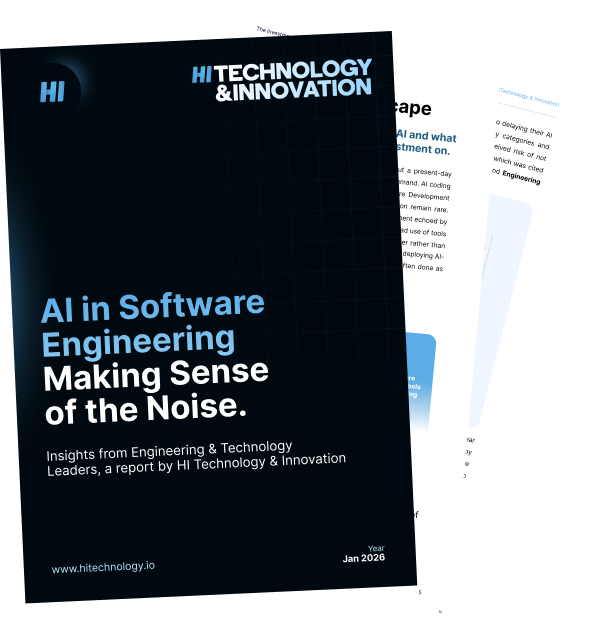
This article covers a portion of our research findings. The full report explores how leading engineering teams are integrating AI, the real impact on productivity and delivery, and the risks, trade-offs, and strategic decisions shaping adoption across the industry.